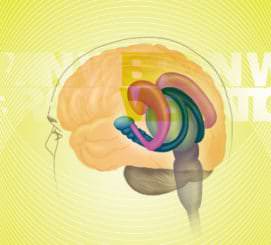
Neurons
Neurons are nerve cells. It is estimated that there are about 100 billion of them in the human brain. They are uniquely structured, with long, tail-like axons that transmit electrical impulses, and spindly branch-like arms called dendrites that receive information from other neurons. There are many different types of neurons, from motor neurons, which control muscle movement, to sensory neurons, which enable us to touch, see, hear, feel, and taste. Neurons are the key to everything our brain does. For many decades, scientists thought we were born with a certain number of neurons, and that was that. We now know that we can grow new neurons at any stage of life.

Axons
Axons are the power lines of the brain, connecting neuron to neuron. Electrical impulses shoot down them, causing the release of neurotransmitters at their tips, which are received by the dendrites of other neurons. This electrical activity can be measured by an electroencephalograph machine (EEG). Brain waves are the collective frequency of these electrical impulses.
Neurotransmitters
Neurotransmitters are the chemical agents that neurons use to communicate with each other. Neurotransmitters can be pleasant like dopamine, which produces a feeling of pleasure, or stressful like adrenaline, which tells the brain to fight or flee.
Dopamine
Dopamine is the key to the brain’s reward system. When we do something that gives us pleasure, it is the result of dopamine being released into our brains. Satisfying hunger and thirst, accomplishing goals, and falling in love will all produce dopamine. When dopamine is released, it actually reinforces the connections that caused it to be released. This conditions our brain to keep engaging in behaviors that make us happy. Normally, this is a good thing. But when people artificially induce a “reward” response by taking drugs, those patterns will be reinforced as well, making it harder to quit.
Synapses
Synapses are the spaces where one neuron meets another. Axons release neurotransmitters into synapses. The neurotransmitters then attach themselves to chemical receptors on the adjacent neuron. In this way, neurons communicate with each other. Each neuron has several thousand synapses, and we have trillions of synapses in our brains.
Neocortex
If the brain were an ice-cream cone, the neocortex would be the top scoop. Divided into left and right hemispheres, it accounts for about 65 percent of the brain’s mass. The thoughts that make us uniquely human, such as logic, personality and language, occur in the neocortex. The neocortex contains the frontal, temporal, parietal, and occipital lobes. In evolutionary terms, the neocortex is the newest area of the brain.
Limbic System
The limbic system is sometimes referred to as the “mammalian brain.” It is the lower scoop on the ice cream cone (because it evolved before the neocortex), and it is responsible for our emotions, instincts and sensory perceptions. The cognitive attributes we share with other animals — sex and survival drives, sensual pleasure, and fear — are rooted in the limbic system.
Brain Stem
The brain stem is the cone that the limbic system and cortex rest upon. It connects the brain to the spinal column. Evolutionarily, it is the most primitive part of the brain. Many of our basic bodily functions are performed here, including breathing, digestion, and heart rate. For this reason, the brain stem is often considered crucial to physical health.
More From Brain World
- Always at the Back of Our Minds: Exploring The Science of Anxiety
- The Chemical Factory Inside Your Head
- From Building Brains to Brained Buildings: An Interview with Michael A. Arbib
- Know Your Brain: The Amygdala — Unlocking the Reptilian Brain
- Music, Rhythm, and the Brain
- Not Fading Away: 6 Ways to Age Gracefully