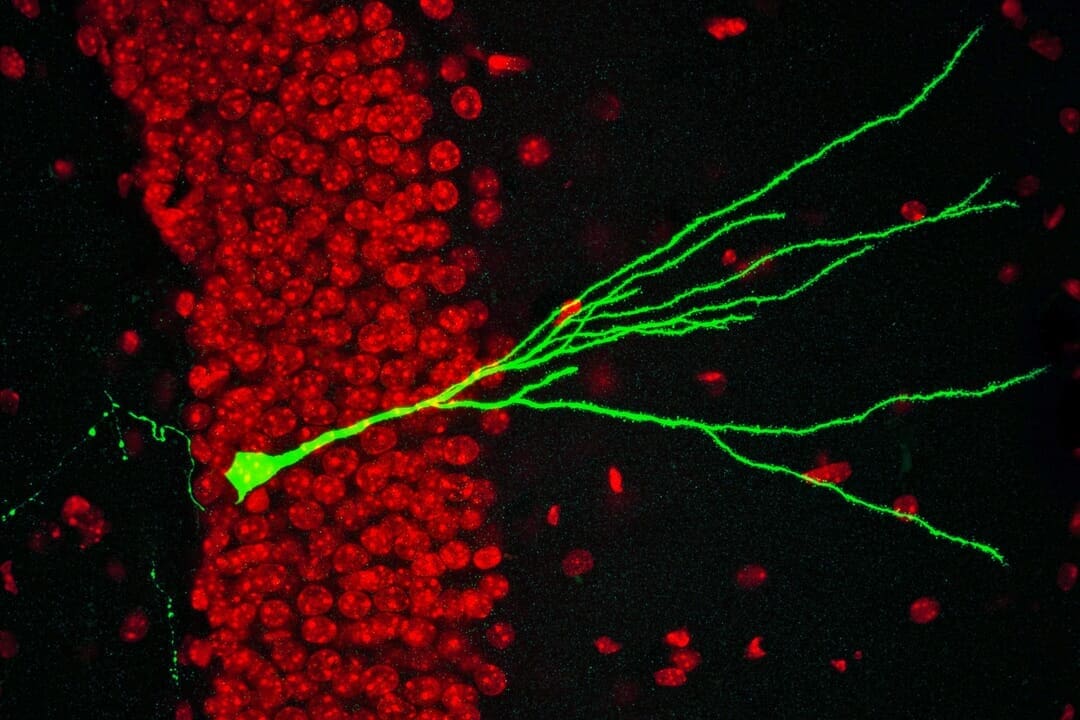

And finally, what allows you to reach into that caldron of protoplasm and pull the memory out when you are asked at your school reunion, “Do you remember so-and-so?” and not only do you remember her, but you remember her vividly.
We are really at a primitive stage in [figuring out] how the brain works. It is very humbling as well as awe-inspiring to be studying an organ that weighs as little as it does and to understand as little about it as we do. The brain has the power to astound us in ways that the other organs really don’t anymore.
BW: It amazes me how little we actually do know about the brain.
RT: It is a problem of bridging together different levels of investigation. We know that it’s not one synapse or one vesicle that’s doing the job — but really thousands and millions of them. The challenge is to understand the organizing principles — the architecture that guides the use of the fragile and unreliable biological processes that make an overall outcome that is far more reliable than its component parts. Every single human behavior on a daily level involves a reliability that we come to expect of our fellow humans. All of this is being generated by synapses that fire on command with a reliability of only about 30 or 40 percent. Reliability relies then, on the ability to organize synapses in such a way so that their unreliable features are being washed out by the organization. And we do not completely understand that organizational feature.
BW: So how does it all work? Why is there reliability at all?
RT: Your experience is, of course, not at the level of what your individual synapses are doing. What we experience is the overall function of the system. Our main focus now is to move from what we know about those incredibly intricate but unreliable synapses and to get to the level where we can understand the calculation the brain is doing, to figure out the guiding principles that enable unreliable synapses to be made into reliable circuits.
BW: So what is the mechanism of memory storage?
RT: The general belief is that much of memory involves modification of the strength of synaptic connections. So if you are reading an article in Brain World, your brain processes that information, and in that processing synapses are being used and activated — and those synapses undergo a lasting change, which changes the properties of the circuits that the synapses are operating within. That change in the circuits’ properties is somehow read out [recalled] for the process of memory retrieval.
Imagine, in the brain, that sensation goes in, action comes out. Do that a few times, and then before we know it we are doing it more vigorously, more efficiently, and somehow that change in the strength of the synapse translates — through processes we do not necessarily understand — into a behaviorally measurable memory.
BW: What about not remembering something?
RT: If you make molecular manipulations that specifically make the synapse modifications go away, you can also abolish either the acquisition or the retrieval of the memory.
BW: Are there ways we can strengthen our memory on a daily, recognizable level?
RT: Neuroscientists generally subscribe to the theory, “use it or lose it.” We honestly believe that if you have an active life and use your brain you are more likely to continue to use your brain. Some people do crossword puzzles, learn new languages, memorize lists. It is not in my province to tell your readers what the best way to go about this is, but I think the most obvious thing I can say is that while the brain has incredibly sophisticated, specialized, and nongeneralized functions, it is also a collection of cells that, like heart cells, kidney, or blood cells, need to be well taken care of. And the obvious ways of taking care of the brain are to get a lot of rest, get good nutrition, exercise it, and, most important of all, get a lot of sleep. There are a lot of things that we know happen during sleep which are specifically organized for the nervous system to replay certain patterns that it experienced, and to consolidate things that need to be remembered, and to also reset itself, so that things that are not to be remembered get dampened down.
This article is an updated version of its publication in the Fall 2010 issue of Brain World Magazine.
Related Articles
- Can Alzheimer’s Be Prevented? An Interview with Dr. Gary Small
- Know Your Brain: The Amygdala — Unlocking the Reptilian Brain
- Memory Keepers: What You Can Do for Your Brain
- Simple Critters and Big Mysteries: An Interview with Dr. Thomas J. Carew
- Video Games According to “Brain Age” Creator Ryuta Kawashima